 Jamie
Jamie
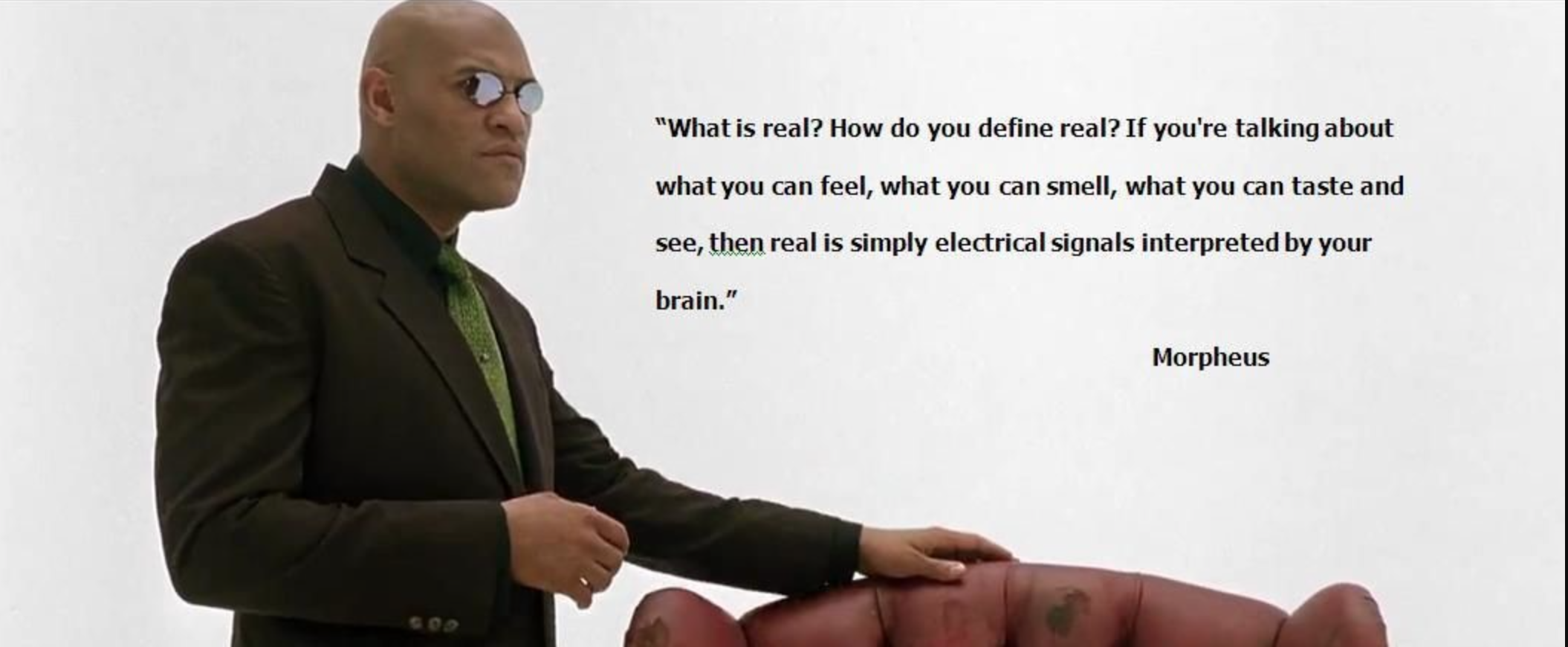
In the 1999 movie The Matrix, the scene What is Real? shows the main character, Neo, connected to a computer simulation by a jack in the back of his head. Once in the simulation, Neo is led by Morpheus to question the nature of his reality. The discussion puts forth a model of human perception in which energy such as light, sound, and heat, along with chemical molecules, impinges on the sensory receptors in the human body. The receptors react by sending impulses through the nervous system to the brain. The brain interprets these impulses and constructs a mental model, which creates an individual’s experience of the world around them: what they see, hear, feel, smell, and taste. Our sensory system samples only a small amount of the energy fields and chemical molecules present in the environment directly around us. Our brains interpolate to fill gaps where data is missing. The sensory processing system can be thought of as our input from the physical world we live in.
The reciprocal output occurs when the brain and nervous system send impulses to effectors, causing the body to carry out actions such as flexing a muscle, blinking the eyes, or using the vocal cords to speak. Many bodily functions occur automatically through the autonomic nervous system. Others operate under conscious control by the individual. However, individuals often overestimate (and sometimes underestimate) how much actual conscious control they exert over their bodily functions.
The fascinating question posed in The Matrix is how you would know the difference between signals supplied to your nervous system by a computer simulation and those from the “real world.”
An important psychological phenomenon to understand is filtering. Our experience is stitched together from samples of data in our environment. Past experience and our belief system have a profound effect on our experience of reality. We make predictions and fill in gaps guided by our beliefs and personal history. Sometimes these efforts are correct. Other times they are inaccurate or distorted. This process is called filtering because of how our experience is altered. Some people are described as looking at the world through rose-colored glasses, meaning that they filter their experience by taking the most optimistic view of situations.
The effects of filtering are most profound in our opinions and judgments about other people and situations. Individuals involved in the same group interaction can report very different interpretations of what just occurred. A common saying illustrates how views can differ: some see the glass of water as half empty and others see it as half full. Filtering can take the form of an internal narrative or thought pattern in which the focus of attention overemphasizes some characteristics while minimizing others.
 Feelings